1992-02-02 - 15:00 - Krefeld - ENGLISH
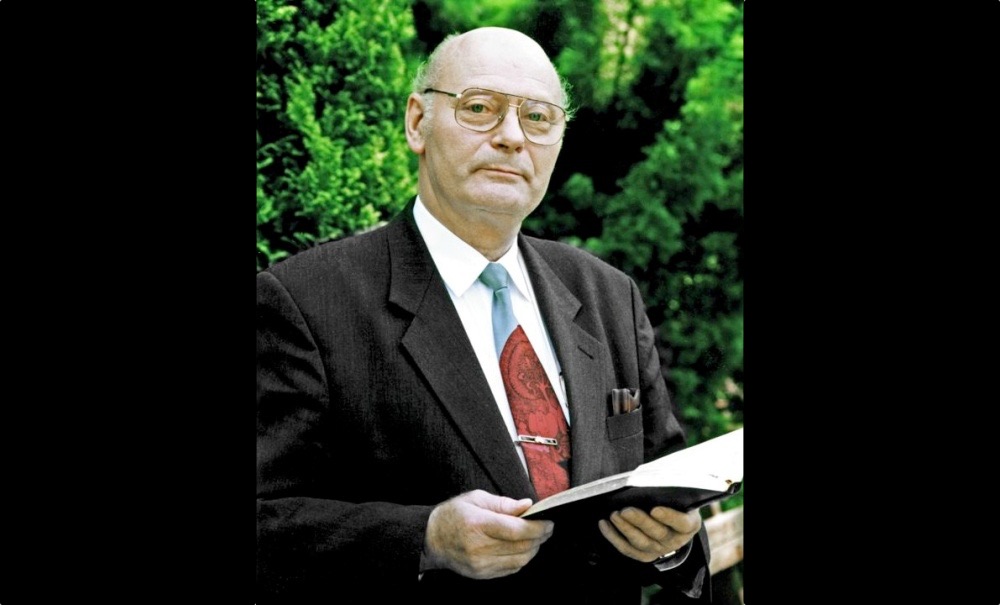
Ewald Frank
preached on 02. 02. 1992, 15:00, Krefeld, Germany
Topic: "Where does God still get his due today?"
broadcast on 11. 11. 2026
We are sincerely grateful to the Lord, and I shall tell you why: because in his faithfulness he still speaks to us. And as long as he still speaks to us, there is great hope for us all. Only when he can no longer speak to us through his Word and through his Spirit—that is to say, when his Word has nothing more to say to us, when his Word does not speak to us, but passes us by on the right and left, and we have our own thoughts within us whilst listening to the Word—only then are we in a sorry state.
If we have truly found grace with God, then what is written in, I believe it is Exodus 33, is fulfilled: “If I have truly found grace in thy sight, let me know thy ways.” [Exo 33:13]
And even if some criticism is directed at us on the grounds that we have not given our attention to the whole world or to all evangelists, but that we have recognized with complete focus the manner in which God has spoken and worked in our time, placing the promises upon the lampstand, our attention has been directed to what really matters now.
And I was indeed very pleased that God had already guided Brother Branham back in the 1960s, when the course of events was still far from clear to us, a course that no one could have foreseen, for at that time the spiritual world still seemed to be in order. I know that the late 1950s and also the early 1960s were times that we look back on fondly. And yet the prophetic eye could already see how events would unfold, and how grateful we can be that a warning voice was raised, and we believe that was the voice of the Lord, who was simply able to use Brother Branham’s mouth to tell us this, and to a large extent to foretell what is now truly going to happen.
Think of the World Council of Churches, of the whole spiritual development, how it was all so skillfully orchestrated, how suddenly people were no longer cursed, but they were told: “You are after all our brothers,” and so on. The whole thing has been so cleverly orchestrated that the general public and even all the theologians cannot see it. Only those to whom God truly opens the eyes, and those are his own. He said: “Whoever follows me will not walk in darkness, but will have the light of life.” [Joh 8:12] Light, even in this dark and perverse world, to have light, to have clarity, to have revelation, so that we may truly recognize what is happening now, and especially in the fact that we have been deemed worthy to believe as Scripture says, not that we take credit for it ourselves. We cannot do that, nor should we. We would have gone the same way as everyone else, had God not had a different purpose for us; had God not had a different path in store for us, we would have gone along with the masses.
Some of us, like myself, actually lived through the revival movements following the Second World War. We were right in the thick of the events of that time. And yet, we did not belong there. The Lord had a path for us. As a hymn writer sings: “The Lord has a way for you, has a way for me, has a way for us, yes, for his people.” And if you read the Book of Acts again, do pay attention to this. It not always says that the Word was preached, but also that a way was proclaimed. I wish I could turn to it. If Brother Russ takes a few minutes later on, I shall turn to those passages. They taught a way. They did not merely preach the Gospel.
They pointed out God’s way. They stated very precisely what lies along this way and what goal is associated with it. It is not merely a doctrine. This doctrine encompasses everything that belongs to it. And we believe that God truly has a way with his people.
As Brother Russ read, spoke, and prayed, I thought, first of all, of John 15, where the Lord says: “Every branch on me that bears fruit, he prunes, that it may bear more fruit.” [Joh 15:2] I believe that when such words, indeed sermons, are delivered to us, as they were yesterday and this morning, then the Lord has something in store for us. These are, after all, sermons that do not flatter us, but sermons through which we are confronted with the Word and can look into it as if into a mirror to examine ourselves and ascertain what state we are in. [Jam 1:23-24] And what is always important is that the Word and the Spirit are in harmony within the blood-bought multitude. Not merely, as some say, “We have the Spirit,” whilst paying no heed to the Word, nor, as others might think, “We have the Word,” whilst paying no heed to the Spirit, but that both work together.
The blood, the water, and the Spirit. [1Joh 5:8] You know, of course, that the Word is like a bath of water which we take time and again, as it is written in Ephesians 5, that we have been “cleansed with the washing of water by the Word.” [Eph 5:26] On the one hand, cleansed by the blood of the Lamb and made white. On the other hand, having taken a full bath in the Word, immersed in the Word, so that everything that is not in accordance with the Word is washed away from us, and we are truly cleansed with the washing of water by the Word of God.
Then, in connection with this sermon by Brother Branham, I could not help but think of the idea we briefly touched upon here a few Wednesday evenings ago. I believe it is Hebrews 10 and Psalm 40, where it is written: “Sacrifice and burnt offerings thou wouldest not, but a body hast thou prepared me.” [Psa 40:6; Heb 10:5]
We have reflected on this passage.
In the Old Testament, men of God did indeed offer sacrifices. The first sacrifice that was pleasing to God was offered by Abel. [Gen 4:4] God looked favorably upon Abel and the sacrifice he offered, sent down fire and declared: “This is pleasing to me.” It was not only the offering, but also the one who offered it who was pleasing to God, because he offered it on the basis of a revelation. [Heb 11:4] Abel knew it was not a matter of apples, which would have led to the fall. It was something quite different. Cain, who had no revelation, offered the fruits of the ground. [Gen 4:3] Yes, but there was no blood in the fruit. And Abel knew what the fall consisted of. He knew what it was all about. And by revelation he shed blood and offered a sacrifice acceptable to God.
Thus, in the Old Testament, sins were initially covered by the blood until the Lord would come as the Lamb of God and could then forgive them entirely.
But what came later was a formality, a tradition. Even in the days of Moses, when everything was still very new, sacrifices were offered out of conviction. People may even have been able to identify with a sacrifice. And they knew: “Actually, I should have had to die, but by God’s grace I am now allowed to slaughter and offer this sacrificial animal.” Yes, but it reached the point where the one offering the sacrifice was no longer fully engaged, and God had to say: “To whom have you offered the sacrifices?” And then he even says: “Sacrifices and burnt offerings thou wouldest not.” [Psa 40:6; Heb 10:5] The one who actually did not want them was the one who offered the sacrifice. He was not focused on the task at hand. He was already thinking about everything else.
As I just said, it became a mere formality. And God never permits a mere formality.
We heard this too in Brother Branham’s sermon. The revivals always began very well. There was no talk of organization, let alone denomination. Everything was fresh. There were brothers and sisters in the Lord who were rejoicing anew because God had accepted them and shown them mercy. After that, things changed again. Then people started organizing. The revivalist preachers were no longer there, nor was the revival. And so it happened, time and again, after every work of God, that it ended up taking on a rigid form. And we have also heard that God always had a remnant with whom he could continue.
From this last one, which Brother Branham referred to as the Pentecostal revival, a remnant has also remained. But not only from this revival, but in all churches and denominations, there are people who are called out and added to the church of the living God. “Sacrifice and burnt offerings you would not.” [Psa 40:6; Heb 10:5] They could not make the one who offered them acceptable before God, because the heart remained as it was before, and the man was no longer fully engaged. It is different now.
We too must be fully engaged when we hear God’s Word. We cannot merely say half-heartedly and listlessly: “we believe that all harm was made good on Golgotha.” We must live out in our lives the divine proof that has been provided, that we have not only believed but also received, and that we are united from the heart with him, the Lamb of God, who was sacrificed for us, that we understand what it cost him to lay down his life so that the same divine life might be in us.
That after all was what it was all about, forgiving our guilt, settling the account for the fall, but that was not all, it was also to give us a new life, to bestow eternal life upon us, and to unite us with himself, for it was God who in Christ reconciled the world to himself, and as those who have been reconciled we may come to the Lord. [2Cor 5:19] As has just been emphasized, in the Old Testament everything remained as it was, the sacrifices were offered, and the one who offered them, perhaps even offering them on behalf of others as high priest, the one who had offered them on his own behalf, was not truly engaged in the act, and the others certainly were not, and this did not please God, he said: “Sacrifice and burnt offerings thou wouldest not, but a body hast thou prepared me” [Heb 10:5], and connected with this is written: “I have come to do thy will, O God.” [Heb 10:7]
I shall read this out to us once more, so that we may know that this offering is indeed linked to the fulfilment of the Lord’s will. It is written in Hebrews chapter 10, Hebrews chapter 10 from verse 5:
[5] Wherefore, when he cometh into the world, he saith, Sacrifice and offering thou wouldest not, but a body hast thou prepared me:
[6] In burnt offerings and sacrifices for sin thou hast had no pleasure.
[7] Then said I, Lo, I come (in the volume of the book it is written of me,) to do thy will, O God.
Here we have it, and we can also see what this is all about. The others who offered sacrifices were unable to do God’s will. As already noted, they remained as they were. Here came one who could say: “Not my will, but thy will be done.” [Mat 26:39; Luk 22:42] Here came one who could become a sacrifice for all, who paid the debt for all, forgave sin and brought new eternal life. One who was able to do the perfect will of God, here on earth, in his flesh, so that all those redeemed by God might be enabled to do God’s will as well.
But this must indeed be our sincere desire, that we too might say: “I delight to do thy will, O my God.” So it is written elsewhere: “I have come to do thy will.” [Heb 10:7] We as the church are on this earth for a divine purpose, namely that the direct will of God may now be accomplished through the church, that the Word of God may be proclaimed and thereby the will of God revealed, and all who are of God submit to and bow to the Word and cry out with all their hearts, in faith, “to do thy will, O God.” That is why we are here. This Word, I shall read verse 9 as well:
[9] Then said he, Lo, I come to do thy will, O God.
In prayer our Lord said: “Thy will be done on earth as it is in heaven.” [Mat 6:10] He did not pray, “My Father who art in heaven,” but “Our Father who art in heaven.” [Mat 6:9] He already saw the church as the firstfruits, us who have likewise been made sons and daughters of God. He prayed with us: “Our Father who art in heaven, hallowed be thy name,” and so on. [Mat 6:9] He has included us in God’s program, in God’s plan. We are no longer guests or strangers. [Eph 2:19]
I urge you from the bottom of my heart to realize what a blessing it is that God speaks to us in this way in these days. And in this connection I ask you, where is the Word of the Lord heard today? Where is it proclaimed? Where can the revelation of the Spirit be heard, seen, or found? It is not there. And this is not a judgment we are making lightly here, perhaps to look down on others.
But just listen for yourselves. In all these lands, where is God still being given his due today? Where are people today truly brought into contact with him? With the true God, with true eternal life, not with religion, a bit of religion here and a bit there, and a bit of framework, atmosphere, as Brother Branham put it, a lovely turn of phrase, when he spoke of the Hollywood style. And I thought to myself, when I was in Hollywood back then, there was a man who worked with Wernher von Braun, and he said to me, whilst I was in Los Angeles: “Let’s pop over to Hollywood.” I said: “If that’s what’s meant to be.” And then I did see quite a few things, among other things, I saw all the handprints of all the film stars who had ever been there, and I thought to myself, where are they today?
And what did Brother Branham say about the most beautiful film actress, Monroe? What did he say? I heard it only recently. He said, word for word: “I have never seen a woman who was as perfectly formed as she was. Whilst she was alive, everyone wanted her, and when she died, they even had to keep her body for a long time, because nobody wanted her anymore.”
And then I thought to myself, what a deception sin somehow inflicts upon people.
Whilst she was alive, they all wanted her. She was the woman of many people’s dreams, wasn’t she? And then Brother Branham says, “when she had died, nobody knew where she belonged, nobody wanted her.” Do you see? That is the deception of sin.
But what I wanted to say is actually something quite different. Not show, not glitz and glamour, but the true proclamation of the Word of God. And from this we recognize how good God is to us. From this we recognize that we have found grace in his sight, because in these days he is making his ways known to us, and drawing our attention to the things that really matter now.
Remember, in the penultimate church age message, in the message to the church in Philadelphia, it is written: “And I will keep you from the hour of trial that is to come upon the whole world.” [Rev 3:10] And this trial is now coming in the final church age, when right and wrong are so closely intertwined, that only the elect will not be led astray into error. As it is written in Matthew 24:24, “that if it were possible, even the elect would be deceived.” That is how similar, how close right and wrong would be to one another.
And then we can always return to the Word of God and use it to examine ourselves and the preaching to see whether this is so. And if it then agrees with the Word, then we know, the same Holy Spirit who rested upon the prophets and the apostles, the Spirit of God, has continued unceasingly in the same way as in the Old Testament, so also in the New Testament. And every word is after all transcendent above all ages. One cannot say that one word belongs to one age and another to a different one. The Word of God belongs everywhere at all times.
And blessed is the person who allows the Word to speak to them, who truly feels that the Word penetrates them, that it has something to say to them, that it is not merely preached, but that it pricks the heart. “Lo, I come to do thy will, O God.” [Psa 40:7-8; Heb 10:7]
There can be two things, on the one hand, that we say with our mouth, “Lord, I am here to do thy will,” on the other hand, however, that we simply say, “Lord, I am here, grant me the grace, not merely to will, but grant me the grace to accomplish, the grace to do according to thy will.” And when we have reached the point where we are ready to do God’s will, then the sermon we heard yesterday and today will not leave us unaffected.
On the contrary, it will stay with us, and we shall be glad to hear it again, to listen to it in prayer, and to say time and again: “Lord, if you speak to us in this way, then grant me also the grace to act upon it, so that we may not be forgetful hearers of the Word, but that we may by grace become doers of that very Word.” [Jam 1:22-25] There is only one scripture that addresses the concern discussed here, that of placing oneself entirely at the Lord’s disposal, and it is found in Romans chapter 12, a passage very familiar to us all, Romans chapter 12. But here too, there can be a great gulf between theory and practice, and that should not be the case, Romans 12:
[1] I beseech you therefore, brethren, by the mercies of God, that ye present your bodies a living sacrifice, holy, acceptable unto God, which is your reasonable service.
[2] And be not conformed to this world: but be ye transformed by the renewing of your mind, that ye may prove what is that good, and acceptable, and perfect, will of God.
If only we could experience this, not merely to speak of the sacrifice that was offered and of the sacrificial lamb that shed its blood, but that we too might say: “Lord, this is your demand, it is made of me personally, here I am, at your service.” We heard again today about Samson. He was there in all his stature, his shoulders were just as broad as before, his arms, everything was there, the muscles, but the power of God was no longer there. In exactly the same way the church as a whole may be present, and if the power of God is not there, what then?
Then let us think of the words of the prophet Ezekiel, who saw many dry bones lying about, and then came the command: “Prophesy and say to the Spirit of life, that he may bring these dry bones together, so that they may all rise up.” [Eze 37:1-10] And so it came to pass. He prophesied and it came to pass.
Beloved, we have heard the words of divine prophecy in these days, and if it is written in the last book of the Bible: “Blessed is the one who keeps the words of the prophecy of this book” [Rev 1:3; Rev 22:7], then we may truly be counted amongst the multitude, who in these days have not been threshing straw and wasting time, but have been deemed worthy to hear the living Word of God, the prophetic Word, not prophecies from some auntie or uncle. Such things have indeed existed, and as far as I am concerned, they may well happen again, if God so wills. But always true, we want nothing else. But there is more to it than that. Holy Scripture even speaks of the Spirit of prophecy and of the testimony of Jesus.
This is recounted concerning the bride in Revelation 19. Revelation 19, verses 9 and 10, earlier it is said: “And his bride hath made herself ready, and to her was granted that she should be arrayed in fine linen, clean and white; for the fine linen is the righteousness of saints.” [Rev 19:7-8] And then it says in verse 9 and 10:
[9] And he says unto me, Write, Blessed are they which are called unto the marriage supper of the Lamb. And he says unto me, These are the true sayings of God.
[10] And I fell at his feet to worship him. And he said unto me, See thou do it not: I am thy fellowservant, and of thy brethren that have the testimony of Jesus: worship God: for the testimony of Jesus is the spirit of prophecy.
This is one of the most important passages in the whole of Holy Scripture. Only where God can reveal himself to a person, where it can truly be said, “the revelation of Jesus Christ, which God gave unto his servants” [Rev 1:1], where it is no longer a person or human influence, but the full revelation of Jesus Christ, that is bestowed upon a person through the Spirit. And here we read about the testimony of Jesus. And then we are told: “For the testimony of Jesus is the spirit of prophecy,” not the gift of prophecy. The gift of prophecy is one of the nine gifts of the Spirit, listed by Paul in his letter to the Corinthians, and there are many who had it and still have it today, yet have absolutely no idea about the spirit of prophecy.
They do not know at all what the Spirit testifies to the churches to this very day. They do not yet know the divine order at all and are in fact going their own ways.
Brother Branham also put it so aptly today, and I don’t want to send you there, nor do I know where such meetings are currently taking place. But anyone who has ever been to charismatic meetings knows how things go there. Everything seems to be in order, hands are raised, there is plenty of praise and worship. Yes, but who is being praised? Who is being worshipped? If Scripture says “God seeks worshippers who worship him in spirit and in truth” [Joh 4:23-24], what then is all this babbling of the Gentiles? Where is God? In what kind of praise does he dwell? In true praise, where there is no mixing or mere enthusiasm, but divine revelation, where the spirit of prophecy can bear witness to Jesus in the church and where people become truthful, so that they may then hear what the Spirit says to the churches and truly share in what God is doing.
It all simply belongs together. Nothing in the Word can be separated, the full gospel, the whole counsel of God is part of it, and we are grateful that it has been proclaimed so beautifully in our day. Grateful also that we have been deemed worthy by grace to share in it, to be in the kingdom of God and to be counted amongst those who are now addressed, people with whom God is now concerned. These are the pardoned ones, these are God’s elect whom the Lord has called out. If God is not concerned with a person, then he lets them go their own way, and they wander in all directions, just not to where they actually belong. So to sum up, we can say that we have found grace in the sight of God.
And as Brother Russ said in the introduction, if we do not praise God, if we do not give God the glory, who then is to do so? I want to tell you what sometimes weighs a little heavily on us. It is the fact that everything takes so long. We had imagined God’s work would be swifter, that it wouldn’t take so long to come to pass. But what does it say in Hebrews? [What does it say in James? “You have need of patience so that you might receive the promise.” [Heb 10:36]
Now it all comes down to patience, that we do not become impatient and think we need to give God a helping hand, but that we persevere in faith, patiently persevere.
It is written in James: “Take the prophets as your example, my brothers, who persevered.” [Jam 5:10-11] The prophets all persevered and saw none of the fulfillment of what they had foreseen in the plan of salvation, which found its fulfillment in Christ. And Branham specifically mentions the prophet Isaiah, who was probably one of those who according to Hebrews 11 was sawn in two, at least that is what is recorded in church history books. [Hebr 11:37] He was placed inside a hollowed out tree trunk and then sawn in two. Hebrews 11 tells us: “The world was not worthy of them, they were stoned, killed, sawn in two, tortured, this world was truly not worthy of them.” [Heb 11:37-38]
But I can imagine, if one could have asked Isaiah in the final moments of his earthly life: “Do you still believe in what you, or rather what the Lord prophesied through you: ‘A virgin shall conceive and bear a son, and you shall call his name Immanuel’?” [Isa 7:14; Mat 1:23] “Do you still believe that he, the Wonderful Counsellor, Mighty God, the Everlasting Father, the Prince of Peace, that this Son will be born?” [Isa 9:6] With his last breath he would have said: “I believe, because God has spoken it.” All these men believed, they knew, this did not come from them, God spoke through them and it will come to pass, they persevered. And in Hebrews it also states, “they persevered in order to share in a far more glorious resurrection.” [Heb 11:35]
And this is precisely the first resurrection of which Paul writes to the Philippians, saying that he hopes to share in the resurrection. [Phi 3:11] The original text actually reads “resurrection”, this refers to the first resurrection, which will be for the perfected, the righteous, for the bride, for the elect. And by grace we may count ourselves among this multitude, this multitude whom God foreknew before the foundation of the world, and this multitude who were already in Christ and were taken out of him to be brought back to him, flesh of his flesh and Word from his Word, life from him, he was therefore not ashamed to call us his brethren. [Eph 5:30; Heb 2:11] And that is why he said: “I ascend unto my Father and your Father, and to my God and your God.” [Joh 20:17]
This is not yet fully comprehensible to us at present, but John writes: “It does not yet appear what we shall be; but when he shall appear, we shall be like him.” [1Joh 3:2]
This is a complete, total and utter redemption of the whole person, soul, spirit and body are all included in God’s plan, right through the transformation of our earthly bodies into the resurrection body, so that we may then be like the Lord, our God, who has shown us so much grace that we are actually at a loss for words. Just consider this, I do not know at the moment what the world’s population is, China alone I believe is 1.1 billion, but the whole world is perhaps 5 billion, it is after all growing ever larger and increasing all the time, and how few take our 80 million in our own country, and then the few who believe with all their hearts. What is left? It is not even 1%, it is a fraction of a percent, a true remnant. [Rom 11:5]
And in this we recognize what grace means.
God chose Abraham from Ur of the Chaldeans and said: “Set out for the land that I will give to you and your descendants.” [Gen 12:1] God has always spoken to those in whom he could place his trust and knew they would believe his Word. God cannot afford to see his Word go unheeded, and that is why he speaks to us, so that we may believe him. “For whoever does not believe him makes him a liar”, as John writes in his letter. [1Joh 5:10] And whoever believes God, in turn confirms that God is true. [Joh 3:33]
And so let us believe with all our hearts, for we do not believe in people, nor in prophets, nor in apostles. We believe in the Lord God, who has revealed himself to us in Jesus Christ for the salvation of our souls. Of course, we are grateful to all the men whom he has used to bring us the living and revealed Word. To him, the Almighty God, be praise and honor, now and forever. Amen.