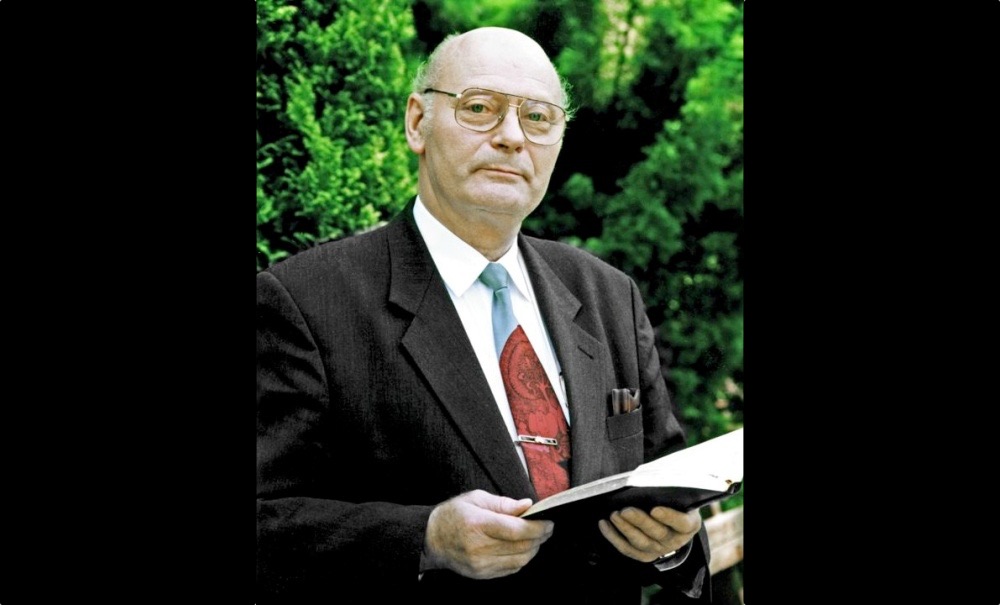
1991-08-11 - 10:00 - Krefeld - ENGLISH
Ewald Frank
preached on 11. 08. 1991, 10:00, Krefeld, Germany
Topic: “There must be no mixing between old leaven and new unleavened bread!”
broadcast on 19. 9. 2026
We are grateful for this day too. It is a day the Lord has made. And the psalmist says: “Let us rejoice and be glad in it and give glory to the Lord.” [Psa 118:24]
I would like to read a few scriptures. From Psalm 124, I would like to read the last two verses and then a few passages from the New Testament. Psalm 124, verses 7 and 8:
[7] Our soul is escaped as a bird out of the snare of the fowlers: the snare is broken, and we are escaped.
[8] Our help is in the name of the Lord, who made heaven and earth.
This too has already been emphasized in the opening word and in what has been said. Men of God and children of God go up the mountain and they also come down again. They go with tears. Their path is not always the easiest. But we have the promise that the Lord is with us always, even to the end of the world. [Mat 28:20]
And as the singers sang in the last hymn: The evening hour has come, the Lord will soon appear with a holy host of angels.
We believe in this place in the imminent return of the Lord. We believe that it will happen in our time, in our generation. We believe this on the basis of the Word of God, because the Lord said: “When you see all these things coming to pass, lift up your heads, because you know… not merely suppose or think or believe, but… because you know that your redemption is drawing near.” [Luk 21:28] There is a divine knowledge, a divine information, based on the things that were foretold and are now being fulfilled.
In this context we are sincerely and honestly grateful to God that he has sent his servant and prophet to bring us the scriptures that are now of importance, to shed divine light upon them, so that God might open our spiritual eyes, anoint them and graciously grant us understanding of the fulfillment of scripture in our day. As always, so too in this age, it is not a prophet or an apostle who accomplishes anything, but God himself through his Word accomplishes that for which it was sent. So it is still written in the prophet Isaiah 55: “The word that goes forth from my mouth shall not return unto me void, but it shall accomplish that for which I sent it.” [Isa 55:11]
We all know that God uses human lips to pass on his Word. And that is why the Word also says in the book of Isaiah: “Blessed are the feet of those that bring good tidings, that publishes peace.” [Isa 52:7; Rom 10:15] They carry the precious seed, and then they return. And God blesses the Word that has been sown.
A few scriptures from the New Testament. And since the wedding guests and the newlyweds are still here, I would like to read the passage from Ephesians chapter 5, which more than any other illustrates the relationship between husband and wife and at the same time between Christ and the church. Ephesians chapter 5, particularly verses 25 and 32:
[25] Husbands, love your wives, even as Christ also loved the church, and gave himself for it;
[26] That he might sanctify and cleanse it with the washing of water by the word,
[27] That he might present it to himself a glorious church, not having spot, or wrinkle, or any such thing; but that it should be holy and without blemish.
When we read such a word—blameless, perfect, complete in the presence of the Lord—and then perhaps look at our own shortcomings, we might ask ourselves: Lord, how is this to be? And the answer is: “Not by might, nor by power, but by my Spirit, says the Lord.” [Zec 4:6] The Spirit of God is at work in the blood-bought multitude until it appears perfected before the throne of God as the reward for the suffering endured at Golgatha. I shall now read—you may all read on if you wish—I shall now read verse 32:
[32] This is a great mystery: but I speak concerning Christ and the church.
Anyone who reads the verses in between will notice that the text goes on to speak of husband and wife and of the union of these two: “A man shall leave his father and mother,” it is said here too, “and the two shall become one flesh” [Eph 5: 31], and as it says in verse 30:
[30] For we are members of his body, flesh of his flesh and bone of his bone.
It is indeed as was already hinted at and briefly noted yesterday: throughout all creation a couple was present from the very beginning; man is the glorious exception, because man was created in the image of God. [Gen 1:27] Just as Eve was initially in Adam and was then taken from him and returned to him, so was the bride of the Lamb, so was the church of the living God in him. [Gen 2:21-22]
And when he came to this earth and his side was pierced on the cross of Calvary, the blood flowed for our redemption and forgiveness, so that a kind of kinship might exist, nothing foreign, but begotten and born of him—Word from the Word, Spirit from the Spirit, life received from God. [Joh 19:34]
Paul described it in a marvelous way, and that is why he too used the scripture. Or as it is written in the gospel: “I am ascending to my God and your God, to my Father and your Father.” [Joh 20:17] There is but “one God and Father of all who is above all and through all and in you all.” [Eph 4:6] And it is written in Hebrews: “Here am I and the children whom God hath given me.” [Isa 8:18; Hebr 2:13] God began with the firstborn, thereby bringing into being the new divine lineage, the children of God after the first model. Earthly there is the first Adam, and then came the second Adam. [1Cor 15:45, 47] And so we who have been born of God are filled with the same life that was in Christ our Lord and Savior.
As regards the proclamation in these end times, it is not merely a matter of preaching anything that happens everywhere. Wherever God speaks in these days, the scriptures are placed upon the lampstand which are now important and embedded within the overall testimony of Holy Scripture. This involves bringing the Old and New Testament into harmony. It involves showing the promises and their fulfillments, indeed illuminating them in the light of scripture.
I would like to read a few passages, whilst also returning to what was already mentioned and briefly touched upon yesterday. In Acts 10, Acts 10 I would like to read verse 39 and perhaps for the sake of context up to verse 43 to show us what really matters, namely the testimony that God had already given through the prophets in the Old Testament. Acts 10, verse 39:
[39] And we are witnesses of all things which he did, both in the land of the Jews and in Jerusalem, whom they slew and hanged on a tree.
[40] Him God raised up the third day and showed him openly,
[41] Not to all the people, but unto witnesses chosen before of God, even to us, who did eat and drink with him after he rose from the dead.
[42] And he commanded us to preach unto the people and to testify that it is he which was ordained of God to be the judge of quick and dead.
[43] To him give all the prophets witness, that through his name whosoever believeth in him shall receive remission of sins.
We recall the words: “You shall call his name Jesus, for he shall save his people from their sins.” [Mat 1:21] We recall the words from Joel 3 and Acts 2: “Everyone who calls on the name of the Lord shall be saved.” [Joe 3:5; Act 2:21] It is striking here that after his resurrection the Lord no longer appeared to the unbelievers, but only to the believers, those who had believed in him, followed him on the path all the way to the cross, and after a brief period of dispersion then gathered together to continue serving their beloved Lord.
Here it says:
[41] Not to all the people, but unto witnesses chosen before of God, even to us, who did eat and drink with him after he rose from the dead.
We recall the words of our Lord: “A little while, and the world sees me no more, but ye shall see me.” [Joh 14:19]
This is still the case today. We can see the Lord walking amongst the seven golden candlesticks. [Rev 1:12-13; Rev 2:1] We can hear him speak. He breaks bread for us, he sets the table for us, he feeds us with fresh manna, with the manna of the revealed Word, which has become our food.
From the Book of Acts, chapter 11, I would actually like to read only verses 12 and 18, but what lies in between is also important. Let us read verse 12:
[12] And the Spirit bade me go with them, nothing doubting.
And then verse 14:
[14] Who shall tell thee words, whereby thou and all thy house shall be saved.
[15] And as I began to speak, the Holy Ghost fell on them, as on us at the beginning.
And also verse 18:
[18] When they heard these things, they held their peace, and glorified God, saying, Then hath God also to the Gentiles granted repentance unto life.
In Acts 2, the sequence is, “Repent, and be baptized every one of you, and you shall receive the gift of the Holy Ghost.” [Act 2:38] Here God has granted room for repentance, bestowing forgiveness by grace through that brief sermon, and the testimony is unambiguous and clear.
I would also like to read from Acts 13, verse 15. Acts 13, verse 15. It says here:
[15] And after the reading of the law and the prophets the rulers of the synagogue sent unto them, saying, Ye men and brethren, if ye have any word of exhortation for the people, say on.
The reading was from the law and the prophets. This is still the case today. Anyone who cannot draw upon the law and the prophets, and who does not wish to impose the law on people, but is instead able to preach Christ from them, such a person has not yet understood the message of the gospel, which is already firmly embedded in the Old Testament.
I would like to read two passages. We read one of them here recently, from the epistle of Peter, 1 Peter 1, verses 10 and 11. 1 Peter chapter 1, verses 10 and 11:
[10] Of which salvation the prophets have enquired and searched diligently, who prophesied of the grace that should come unto you.
Where did they prophesy? One must read the prophets to find the divine message there, the message of grace. We could now turn to Hebrews, to read how Moses was to bear witness to what was to be proclaimed as revelation. [Heb 3:5] In the very heart of the law, God announced grace. In the midst of condemnation, he held out the prospect of forgiveness that would come through Christ. “Concerning this salvation,” so it is written here, “the prophets have enquired and searched diligently, who prophesied of the grace that should come unto you.” [1Pt 1:10]
Ask today’s priests, ask today’s preachers, where in the Old Testament these passages are in which grace was prophesied, and then they will have to admit that they do not read the Old Testament at all, do not know it at all, have no foundation of faith beneath their feet, and that is why they waver and totter to and fro.
A second passage, which states even more clearly what we wish to place on the lampstand here today, can be found in Hebrews chapter 11, verse 24. Hebrews chapter 11, verse 24:
[24] By faith Moses, when he was come to years, refused to be called the son of Pharaoh’s daughter;
And now comes the sentence, or rather the two verses:
[25] Choosing rather to suffer affliction with the people of God, than to enjoy the pleasures of sin for a season;
[26] Esteeming the reproach of Christ greater riches than the treasures in Egypt: for he had respect unto the recompence of the reward.
But Christ had not even been born in Moses’ time. How could he regard the reproach of Christ as a greater treasure than all the treasures of Egypt? He was a prophet. He declared, “God will raise up for you a prophet like me from amongst your brothers, and every soul who does not listen to that prophet shall be cut off from the people.” [Deu 18:15, 18-19; Act 3:22-23] These prophets foretold Christ. And to a certain extent they already bore the reproach of Christ. They took everything upon themselves, because God had them proclaim the history of the plan of salvation in advance.
Anyone who has read the New Testament right up to the last chapter of the book of Acts and beyond will realize that the men of God did indeed use the Old Testament, because there was no New Testament yet, and because there is now a New Testament, we take both the Old and the New, and bring forth the divine truths and show them to the people, so that all may come to faith.
Acts 28, verse 23:
[23] And when they had appointed him a day, there came many to him into his lodging; to whom he expounded and testified the kingdom of God, persuading them concerning Jesus, both out of the law of Moses, and out of the prophets, from morning till evening.
This is true apostolic preaching, a genuine commission from God, to summarise the entire revelation and pass it on to the people.
Another thought has been on my mind, namely the thought which we also touched upon briefly yesterday, that all traditions and teachings which do not come from God are to be cast aside. You know of course, and housewives in particular know, what leaven is all about. We have all seen it. Our mothers and grandmothers used to bake bread. You take a portion of the leftover dough and set it aside. And do you know what happens to the portion that has been set aside in this way? Nothing. Absolutely nothing. There is not a single movement in this dough that has been left behind intended for the next time. Nothing happens. It remains just as heavy, just as large, with no life in it. Everything stays the same.
But when the next day comes, when the dough is to be mixed again, and this leftover sourdough is added to the new batch, well, then it is kneaded, then it gets warm, then movement enters into everything, not before. Only then, when new bread is baked, only then does movement come into the old mixture, not before. You don’t need to be a baker to understand this. What does this tell us? God has always done something new.
And now it is important. I would like to read two scriptures to you, so that it is properly understood. For, strangely enough, the kingdom of God is also compared to leaven. It is almost incomprehensible to us. But that is how it is. And that is why I will read these scriptures, so that everyone knows that this is what is written.
One is the one we already know. In Matthew chapter 16, verses 11 and 12:
[11] How is it that ye do not understand that I spake it not to you concerning bread, that ye should beware of the leaven of the Pharisees and of the Sadducees?
[12] Then understood they how that he bade them not beware of the leaven of bread, but of the doctrine of the Pharisees and of the Sadducees.
But if there is a passage, and there is in Matthew chapter 13, for example, and in other Gospels, it is written here, Matthew 13, verse 33:
[33] Another parable spake he unto them; The kingdom of heaven is like unto leaven, which a woman took, and hid in three measures of meal, till the whole was leavened.
Who can make sense of this? One thing is written here, the other there. The Lord said both, one in connection with the doctrine of the Pharisees and Sadducees, and the other in connection with the kingdom of God. [Mat 13:33; Mat 16:11-12] Look, we simply have to understand this very well.
That which is divine, left over from the previous day, can be put back into the new thing that God gives, and then the whole thing comes to fruition, then life comes into it. In exactly the same way, when the old wrong is transformed into a new wrong, then the matter also begins to ferment and swells anew. So, we must take care, not to mix things up, but to combine the divine that was before with the divine that is here now, so as to keep the whole matter divine.
For we have read after all, that the kingdom of God is likened in precisely this way. [Mt 13:33] And for this very reason, God gave fresh manna on all those days. Throughout the seven church ages, he has used the time to place the old and new upon the lampstand. There is indeed a scripture in the Gospel of Matthew, stating that someone trained in the kingdom of God unites the old and the new. It is found in Matthew 13, Matthew 13, verses 51 and 52:
[51] Have ye understood all these things? They say unto him, Yes, Lord.
[52] Then said he unto them, Therefore every scribe which is instructed unto the kingdom of heaven is like unto a man that is an householder, which bringeth forth out of his treasure things new and old.
Now we might ask, Where then is this school of the kingdom of heaven? If one were to ask in earthly terms, Where are the denominational seminaries? One would know exactly where they are. All the educational institutions, the universities, the Bible colleges, everyone would know exactly where they all are. What then of the kingdom of God? What of the school of the kingdom of heaven spoken of here?
Look, God has arranged it so that he does nothing on earth unless he reveals his secret to his servants the prophets. [Amo 3:7] Men who were united with God in the spirit, men who experienced the presence of the Lord and through the inspiration of the Holy Spirit proclaimed what God spoke through them. And all who hear this divine teaching and are in the same spirit as the apostles, namely in the spirit of God, will through the anointing of the Holy Spirit receive the same revelation from God in all things under the same proclamation just as the prophets and apostles received it from God. Not having known it beforehand, not having known everything already, but in the presence of the Lord we hear the revealed Word.
And under the sound of the revealed Word the same thing is revealed to every individual who seeks and finds a connection with God through the same Spirit.
Let us ensure that Ephesians 5 is fulfilled in us too, that we may belong to the Church of the Firstborn, as it is written in Hebrews, which will then stand before Him on the day of Jesus Christ, blameless, without any spot or wrinkle, without leaven, without mixture, without anything, only that which comes from the Kingdom of God belongs in the Kingdom of God, only that which is found in the Word of God belongs within the Word. And just as Christ was the Word made flesh, so the Church must be the Word made flesh. [Joh 1:14] Just as all the promises made concerning Him were fulfilled in Him, so now everything written for the Church in the Word of God must be fulfilled in the Church.
And as has just been emphasized, let us take care not to mix leaven, old leaven, with a new. Only that which was already in the Kingdom of God and stands firm before God can be taken up, so that new life may spring forth from God, and God may bless anew. Everything that is not of the Word is not of God. And if such a mixing were to continue right to the end, if, like the housewives, if we were all to start kneading with the old leaven, what good would it all do? It would completely leaven the new dough as well. And that is why we want to cast aside everything, every doctrine, however precious it may be to us, and accept what God has given us.
Not to mix two different things together, but to leave together what belongs together. And the only things that belong together are what is taught in the Word, what is promised and what is written in the Old and New Testament. One can neatly incorporate what is in the Old Testament into the New and then everything agrees. But if one takes things that have been introduced and taught over the centuries and then incorporates them into what God has revealed, what then? Then the new dough is of no use at all. On the contrary. Then we have corrupted the new thing that God grants by His grace. And it is of no use to us.
Therefore, as Paul said, and as we read yesterday from 1 Corinthians 5, let us become thoroughly new dough, so that the old which has been given to us in the Word may be placed within it that it may be bread and food in the house of God, not the old leaven of the scribes, but the ancient Word of God placed anew where it belongs. And then the whole church can sit at the Lord’s table and be abundantly satisfied with the fatness of the house of God. [Psa 36:8]
Let me say in closing. In his faithfulness God has time and again ensured that he sent his servants and prophets at all times to call his people back to himself and to his Word. One cried out to the people, “How long will you waver between two opinions?” [1Kin 18:21] Another proclaimed, “Let every nation walk in the name of its God, but we will walk in the name of the Lord our God.” [Mic 4:5] Time and again there were men of God who demanded that the people make a decision. They could not let the people go their own way. They had to call the people to make a decision.
It is exactly the same in these days. If the Lord has already given the promise, “Behold, I will send you the prophet Elijah before the great and dreadful day of the Lord comes,” then let us at least understand what such a ministry entails. [Mal 4:5] And if this man of God were to come before the great and dreadful day dawns, a day which will burn like an oven, in which the wicked will be like straw, then he must necessarily come at the end of the day of salvation. [Mal 4:1] And today we can say with a clear conscience, this scripture has been fulfilled in our generation.
God has placed the prophetic word in its original form upon the lampstand. He has taken from the old, placed it into the new, and behold, life has come, and the people of God have been nourished anew with the bread of life. So no mixing, but rather what belongs together, from the old into the new, to see what God has promised and what He has done. By His grace he has rebuilt the altar, just as Elijah did in days gone by, the Lord by His grace, just as there were twelve stones, according to the twelve tribes in those days. [1Kin 18:31-32] He has re-established the doctrine of the twelve apostles as a standard, as a guide, binding upon the church of the living God, which will then in its perfection be prepared and adorned without spot or wrinkle to meet the Lord.
Blessed are all those who do not allow themselves to be held back and who may be told, “You are running after a man.” No one says a word when the whole world follows the Pope or great evangelists who have made a name for themselves through great wealth, great fame, and much talk, no one says a word then. But when a few people are found to whom God has granted grace to hear the Word of the hour, then the whole world is angry with us for it.
We are not ashamed of this, but thank God for the true privilege bestowed upon us of having seen and witnessed how the old has been taken into the new, and how God has bestowed His blessing upon all in His kingdom out of grace. And whoever is of God hears His voice [Joh 8:47], and His voice is His precious and holy Word which remains forever, and all who have taken this Word into their hearts will remain with the Lord forever.
May God bless us all together, fulfil His word for us, and establish an intimate relationship between us and Him as between bride and bridegroom, so that He may bring us back to our first love. There is the passage in Malachi chapter 2, where God speaks to Israel as His betrothed wife, who has broken the covenant and the marriage with Him. And then there is that one verse, what does the one desire, namely God’s seed. [Mal 2:14-15] God’s seed, that is what is written there. I can read it out to you. What is it all about?
And when does the seed come? When does new life come? When two are united in love. Not just talking about love, not just dreaming of it, but being united in love.
Then comes seed, then comes life, then people are born again unto a living hope. Only where there is true union between the bride and the bridegroom will God bring forth new life, which is born like the dew of the dawn. Where people turn their backs on one another, where there is no union, what can possibly happen there? Nothing happens there in the earthly realm and nothing happens there in the spiritual realm.
United with God, flesh of His flesh, bone of His bone, united with Him in love, becoming one, so that new sons and daughters of God may be conceived and born of the seed of the Word, yes, born again, unto a living hope by virtue of the resurrection of Jesus Christ from the dead.
Our God is a good God. He has thought of everything and He will finish His work and then we shall rest with Him and reign and rule with Him and be with Him forever. Amen.